
On the Street Monthly – Market Strength vs August Weakness
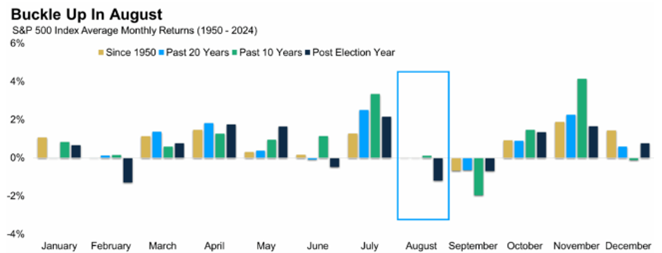
The S&P 500 has surged more than 30% since its April lows, reaching new all-time highs. While investor confidence remains cautious rather than euphoric—which is a positive sign—August has historically been a tough month for the market, particularly in post-election years. Below is a chart showing the S&P 500’s monthly returns since 1950, highlighting the performance of August.
(Source: Carson Insights)
While seasonality shouldn’t be the sole factor in making investment decisions, it’s important to recognize that August and September have historically been weaker months for the market. Since 1950, August has posted six consecutive negative returns during post-election years of second-term presidents. Given the market’s strong rally from recent lows, some pullback or weakness now would be a normal part of the cycle. This doesn’t signal the end of the bull market but rather a healthy pause that investors should expect.
The Interest Rate Debate
President Trump has been outspoken in urging Fed Chairman Jerome Powell to cut interest rates. However, at the July meeting, Powell not only held rates steady but also cast doubt on a possible cut at the September meeting. Adding to the complexity, the July jobs report came in weaker than expected—an important factor since the Federal Reserve’s dual mandate focuses on managing both unemployment and inflation. Although the unemployment rate remains low by historical standards, the softer jobs data could signal early signs of a slowdown. Meanwhile, despite inflation trending downward in 2025, ongoing tariff uncertainties have made the Fed cautious about lowering rates.
(Source: CME FedWatch)
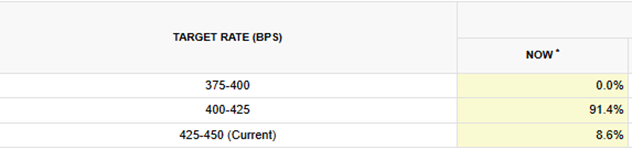
In the chart above, the futures market is pricing in a 91.4% probability of the first rate cut occurring in September 2025. Looking ahead to year-end, the market expects roughly an equal chance of two or three rate cuts. While interest rate futures are always subject to change, current probabilities strongly suggest that the Federal Funds rate is likely to decline in the coming months.
How AI is Supporting the Economy
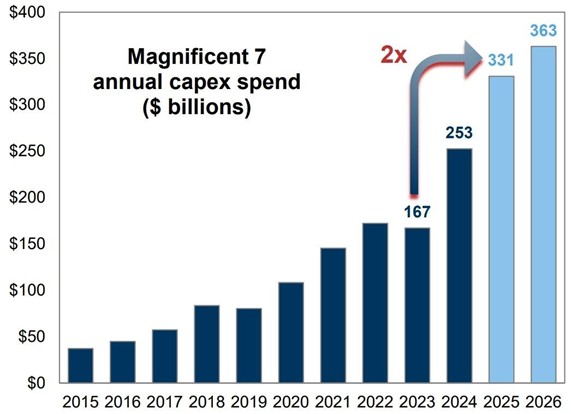
In 2025, the U.S. economy is experiencing a notable shift: AI investment has become a more significant driver of GDP growth than consumer spending. This trend marks a departure from the traditional economic model, where consumer expenditures typically account for approximately 70% of GDP. AI-related capital expenditures, encompassing investments in data centers, chips, and software, have contributed more to economic expansion in the first half of 2025 than consumer spending. Major technology companies, including Meta, Microsoft, and Nvidia, are collectively investing over $300 billion in AI infrastructure this year, underscoring the sector’s pivotal role in the current economic landscape.
(Source: Goldman Sachs)
Conversely, consumer spending has shown signs of stagnation. Despite a low unemployment rate of 4.2%, job creation has been modest, and wage growth is easing, leading to reduced consumer expenditures. Inflation remains elevated, particularly in goods prices, partly due to recent tariffs, which has kept the Federal Reserve from cutting interest rates. Additionally, high interest rates are impacting rate-sensitive sectors like housing, contributing to economic deceleration. Without the robust growth in AI-related spending, the economy might be at risk of stalling.
Articles We’re Reading
EU to suspend US tariff countermeasures for 6 months following deal with Trump (Reuters)
Tesla board approves Elon Musk stock award worth $29B (Yahoo Finance)
Global M&A has reached $2.6 trillion, the highest for the first seven months of the year since the 2021 (Yahoo Finance)
Goldman Sachs says US housing to remain weakest part of economy, falling 8% (CNBC)
Market Snapshot
For the Month Ending 7/31/2025 (Cumulative Returns)1

1Source – Morningstar, Inc. Corporate Bonds is presented as the iShares iBoxx $ Investment Grade Corporate Bond ETF. Municipal Bonds is presented as the iShares National Municipal Bond ETF. High Yield Bonds is presented as the iShares iBoxx $ High Yield Corporate Bond ETF. 10 Year Treasury refers to the valuation of a 10 Year Treasury Note, a debt obligation issued by the U.S. Department of the Treasury. Fed Funds Target represents upper limit of the federal funds target range established by the Federal Open Market Committee. Inflation Rate provided for the purposes of this report by the U.S. Bureau of Labor Statistics. Unemployment Rate calculated by the U.S. Bureau of Labor Statistics. WTI Crude Oil refers to the price of a barrel of West Texas Intermediate NYMEX) Crude Oil. Gold – Spot Price relates to the valuation of an ounce of gold, as traded on the NYSE Arca Exchange. U.S. Dollar refers to the U.S. Dollar Index (DXY). All Returns are denominated in USD (United States Dollar), unless otherwise explicitly noted.
Did You Know?
Back-to-school spending in 2025 is expected to hover around $30.9 billion—about the same as last year—even though prices for things like electronics and clothes have gone up. Families are using their dollars, hunting for deals using AI tools, social media, and leaning into “Buy Now, Pay Later” options.
After a decade of rising costs, this year’s steady spending shows that parents are balancing budgets with a bit of tech, AI and paying later to get kids ready for the upcoming school year.
Presented by the Investment Committee of Lake Street, an SEC Registered Investment Adviser
The information contained herein constitutes general information and is not directed to, designed for, or individually tailored to, any particular investor or potential investor. This report is not intended to be a client-specific suitability analysis or recommendation, an offer to participate in any investment, or a recommendation to buy, hold or sell securities. Do not use this report as the sole basis for investment decisions. Do not select an asset class or investment product based on performance alone. Consider all relevant information, including your existing portfolio, investment objectives, risk tolerance, liquidity needs and investment time horizon. Diversification does not ensure a profit or guarantee against a loss. There is no assurance that any investment strategy will be successful. Investing involves risk and you may incur a profit or a loss.
